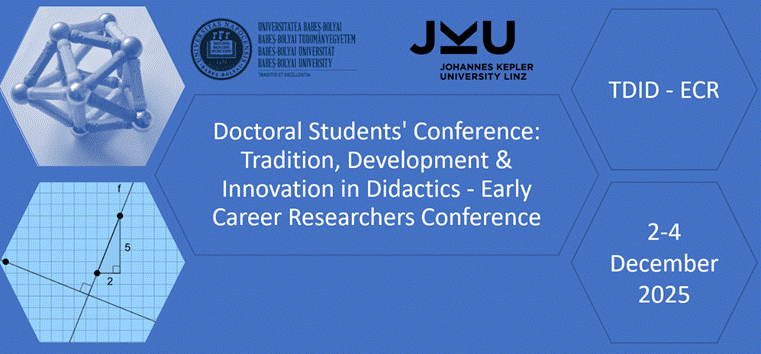
6th Doctoral Students' Conference:
Tradition, Development & Innovation in Didactics - Early Career Researchers
Conference
(TDID
- ERC)
Organized
online between 2-4 December 2025 by
"Didactics:
Tradition, Development & Innovation” Doctoral School at Babeș-Bolyai
University, Romania
Linz
School of Education at Johannes Kepler University, Austria
AIM OF THE
CONFERENCE
The
conference aims to bring together PhD students from Educational Sciences,
especially those who are working in Didactics of different school disciplines.
The conference gives the opportunity to participants for present their wok and
for meeting and networking other PhD students who are working on the same
research issues. PhD students also can take part in the organization of this
conference and chair sessions, gaining valuable experiences. Some of the
keynotes are given by fresh PhD holders to give an insight in conducting PhD
research with its ups and downs, encouraging in this way current PhD students
in their work.
REGISTRATION FOR PRESENTERS/PARTICIPANTS
PhD students can
present their work in short, 10 minutes long presentations. Besides new
research results you can present an already published research or research in
progress. There are three threads of the conference, English, Romanian, and
Hungarian.
For
registration, please, fill in the registration
form for presentation and participation here There is no registration fee.
Deadline: 20 November 2025 24 November 2025 for presenters, 25
November 2025 27 November 2025 for participants without presentation.
INVITED SPEAKERS
|
|
|
|
|


PROGRAM
The conference is organized online. Registered presenters and
participants will receive an email with further information about the access to
the platforms used for the conference.
2 December 2025,
Tuesday (UTC+2
– Cluj time)
17:00 - 17:05 – Opening the Hungarian session – Iuliana
Zsoldos-Marchiș (Babeș-Bolyai University, Romania)
– Iuliana Zsoldos-Marchis (Babes-Bolyai University, Romania)
17:05 - 17:30 - Keynote 1 – Ágnes
Magyari (Babeș-Bolyai University, Romania): Consistency Effect in Word Problems:
Perspectives of Primary School Pupils and Teachers
17:30 – 18:30 Short presentations, parallel sessions 1
|
|
Short
presentations 1.1 – chair Edina Opriș (Babes-Bolyai University, Romania) |
Short
presentations 1.2 – chair Boróka
Csíki (Babes-Bolyai University, Romania) |
|
17:30-17:45 |
Ildikó Vörös (Eötvös
Loránd University, Hungary): Bridging Two Worlds: Conceptualising the
Cooperative Learning of Hungarian Vocational Teachers in School–Enterprise
Partnerships |
Márk Kovács
(University of Debrecen, Hungary): Technology Acceptance Models and the
Interrelations of Teachers’ AI Attitudes |
|
17:45-18:00 |
Géczyné Simon Rózsa Anikó
(University of Pécs, Hungary): The Sociological Implications of Philosophy
for Children in Light of the Latest International Research |
Johanna Tripo (Partium Christian University, Romania):
Non-Digital Tools in Mathematics Education – A Meta-Analysis of Primary and
Middle School Research |
|
18:00-18:15 |
Nándor Vona
(University of Debrecen, Hungary): Social Media Presence of the Units Related
to Teacher Training at the University of Debrecen |
Tibor Kiss
(University of Pécs, Hungary): Health-Conscious and Sustainable Dietary
Attitudes Among Youth |
|
18:15-18:30 |
Edina-Timea Opriș (Babeș-Bolyai University, Romania):
Experimenting Gamification at the Mathematics Course for Future Preschool and
Primary School Students |
|
18:30 - 18:45 – Discussions and closing
3 December 2025,
Wednesday (UTC+2
– Cluj time)
17:00 - 17:05 – Opening the Romanian session – Ioana Magdaș (Babeș-Bolyai University, Romania)
17:05 - 17:30 - Keynote 2 – Lavinia Șuteu (Babeș-Bolyai University, Romania): Exploring the road of doctoral
studies: Challenges, transformations, and pathways to success
17:30 – 18:30 Short presentations, parallel sessions 2
|
|
Short
presentations 2.1 – chair Ilinca Tudorici (Babes-Bolyai
University, Romania) |
Short
presentations 2.2 – chair Victoria Nicoleta Tira (Algeorge)
(Babes-Bolyai University, Romania) |
|
17:30-17:45 |
Anamaria-Mădălina Sabou (Babeș-Bolyai University, Romania): Creativity and Cognitive
Flexibility in Children with Autism Spectrum Disorder |
Ionela-Mihaela Ouatu (Alexandru Ioan Cuza University, Romania):
Determinants of School Dropout in the Context of the Accelerated
Digitalization of Society |
|
17:45-18:00 |
Anca Cristina Ivașcu (Babeș-Bolyai University, Romania): Influence of
Divorce on the Religious Development of Children |
Maria Enăchescu
(Babeș-Bolyai University, Romania): Educational Management and Leadership in
Romania: Approaches and Perspectives |
|
18:00-18:15 |
Alina Mihaela Popescu (Corici) (Babeș-Bolyai University, Romania): Teaching
Strategies Used in the Inclusive Approach to Children with Special
Educational Needs |
Alexandra Rebeca Măduța (Babeș-Bolyai University, Cluj-Napoca, Romania): The
Correlation Between Emotional Awareness and Growth Mindset in Primary School
Students |
|
18:15-18:30 |
Ruxandra
Cornelia Ileana Lăcătuș (Babeș-Bolyai University, Romania):
Exploring Preschool Teachers’ Perceptions and Interest Regarding the
Introduction of an Optional Good-Manners Course for the Socio-Emotional
Development of Preschool Children |
Victoria Nicoleta Țira (Algeorge) (Babeș-Bolyai
University, Romania): Challenges, Opportunities, and Barriers in Developing
Communication with Preschoolers from the Perspective of Early Childhood
Education Specialists |
18:30 - 18:45 – Discussions and closing
4 December 2025,
Thursday (UTC+1
– Linz time)
13:00 - 13:10 – Opening the English session – Selen Galiç & Mathias Tejera (Johannes Kepler
University, Austria) & Iuliana Zsoldos-Marchiș
(Babeș-Bolyai University,
Romania) –
13:10 - 13:40 - Keynote 3 – Prof. Yusuke Morita (Waseda University, Japan - Visiting Professor at Finnish
Institute for Educational Research, University of Jyväskylä, Finland): STEAM Education in Japan - Current Status and Issues
13:40 – 15:00 Short presentations, parallel sessions 3
15:00-15:15 - Break
15:15 - 15:45 - Keynote 4 –Prof. Irina
Lyublinskaya (Columbia
University, USA): Development
and Validation of a Pedagogical Framework for AI Literacy Integration
15:45 – 16:45 Short presentations, parallel sessions 4
|
|
Short
presentations 3.5 – chair Prof. Dr. Chantal Buteau (Brock University, Canada) |
Short
presentations 3.6 – chair Ioana-Luciana Opriș (Babes-Bolyai
University, Romania) |
Short presentations 3.7 – chair Dr. Tony
Houghton (Johannes Kepler University, Austria) |
|
15:45-16:00 |
Aziza Samatova (University
of Debrecen, Hungary): Challenges and Opportunities of Implementing the
Complex Subject Science in Uzbekistan’s Primary Schools |
Fatma Simsek (University of East Anglia, United Kingdom): Development of Formative Assessment Tools for
Inclusive STEAM Education in Virtual Reality and Augmented Reality
Environment |
Sara Boudraa (University of Pécs, Hungary): The Role of Academic Locus of
Control and Technology Use in Predicting EFL Learners’ Language Learning
Motivation: A Pilot Study |
|
16:00-16:15 |
Alexandre Trocado (Johannes Kepler University, Austria):
Artificial Intelligence and Computer Algebra Systems as Mediational Tools for
Advanced Mathematical Reasoning: A Participatory Action Research with
Teachers |
Vanessa Schwarzinger (Johannes Kepler University, Austria): Learning from mistakes: Study
and Intervention to foster a positive error climate in school classes |
Joyce Vogel (Johannes Kepler University, Austria; Jerusalem College of Technology, Israel): Applying Hofstede’s Framework of Cultural Dimensions to
Enhance an Israeli Learning Style |
|
16:15-16:30 |
Sara Alemany Calero (University di Valencia, Spain):
Linguistic Didactics 4.0: Towards the construction of an innovative
methodological model for teacher training based on creative writing and AI |
Cecilia Russo (Johannes Kepler University, Austria): Designing Gamified Learning
Environments Based on Self-Determination Theory and Student Engagement in
Mathematics |
Sabine Leonhartsberger (Johannes Kepler University, Austria): Phenotypes
in Childhood Apraxia of Speech – Methods and Descriptives |
|
16:30-16:45 |
Abigail Gonzales (Johannes Kepler University, Austria): From Data
to Algorithms: A New Pathway for Developing Teacher Readiness in the AI Age |
Gertraud Erlacher (Johannes Kepler University, Austria): Validity, feasibility, and
reliability of an adapted version of the LAMS (Language-Neutral Assessment of
Motor Speech) in Austria |
16:45 - 17:00 – Discussions and closing
ABSTRACTS
Hungarian section, Romanian section, English section
SCIENTIFIC COMMITTEE
Ciascai Liliana,
Babeș-Bolyai University, Romania
Costescu Cristina, Babeș-Bolyai University, Romania
Crișan Claudia, Babeș-Bolyai
University, Romania
Dana-Picard Noah, Jerusalem College of Technology, Israel
Diego-Mantecon Jose, Universidad de Cantabria, Spain
Dulamă Maria-Eliza,
Babeș-Bolyai University, Romania
Fenyvesi Kristóf, University of Jyväskylä, Finland
Hershkovitz Sara, Center for Educational Technology, Israel
Korenova Lilla, Comenius
University in Bratislava, Slovakia
Kreis Yves, University of Luxembourg, Luxembourg
Langa Claudiu, Polytechnical University of Bucharest
Lavicza Zsolt, Johannes
Kepler University, Austria
Magdaș Ioana, Babeș-Bolyai
University, Romania
Opriș Dorin, "1 Decembrie 1918" University of Alba Iulia, Romania
Péntek Imre, Babeș-Bolyai University, Romania
Pinto M. A. Carla , Porto University, Portugal
Ravanis Konstantinos, Patras University, Greece
Steinbeiß Gregor,
University of Education Upper Austria, Austria
Zsoldos-Marchis Iuliana, Babeș-Bolyai University, Romania
ORGANIZING COMMITTEE
Algeorge Victoria
Nicoleta, Babeș-Bolyai University, Romania
Baboș Ioana-Aurelia, Babeș-Bolyai
University, Romania
Bota Nicoleta, Babeș-Bolyai University, Romania
Buteau Chantal, Brock University, Canada
Csíki Boróka, Babeș-Bolyai
University, Romania
Enăchescu Maria,
Babeș-Bolyai University, Romania
Galiç Selen, Johannes Kepler
University, Austria
Gonzales Abigail, Johannes Kepler University, Austria
Houghton Tony, Johannes Kepler University, Austria
Lavicza Zsolt, Johannes
Kepler University, Austria
Opriș Edina, Babeș-Bolyai
University, Romania
Opriș Ioana-Luciana,
Babeș-Bolyai University, Romania
Pop Cristina Florina, Babeș-Bolyai University, Romania
Setiyawan Andri, Johannes
Kepler University, Austria
Sri Padmi Russasmita, Johannes Kepler
University, Austria
Tejera
Mathias, Johannes Kepler University, Austria
Tudorici Ilinca, Babeș-Bolyai
University, Romania
Zsoldos-Marchis Iuliana, Babeș-Bolyai University, Romania
PREVIOUS CONFERENCES


